REVIEW · CARTAGENA
Cartagena Luxury Classic Car Tour + Bilingual Historian Guide
Book on Viator →Bookable on Viator
One classic car ride can change how you see a city. This Cartagena tour threads the historic center and Getsemaní in about 90 minutes, with photogenic stops at the Walls, clocks, plazas, and forts.
I love the “drive-by, stop-and-stare” rhythm. You get short time at each landmark—enough to get your bearings fast—without turning the day into a museum marathon.
One thing to consider: language support can vary by your exact guide setup. Some experiences described as bilingual weren’t fully English-speaking in practice, so it’s worth confirming what you’re booking.
In This Review
- Key highlights you’ll care about
- Why Cartagena by classic car feels different than walking
- Price and group size: what $169 really buys you
- The 90-minute route: a smart way to cover Cartagena fast
- Centro Histórico, the city walls, and Torre del Reloj
- Las Bóvedas and Getsemaní: where the story turns darker and more social
- Plaza de los Coches, Plaza Santo Domingo, and the “instant Cartagena” squares
- Teatro Adolfo Mejía (Heredia): European-style theater in Cartagena
- Catedral Santa Catalina and Castillo de San Felipe: two big icons, two different moods
- Old shoes, nightlife squares, and the best photo energy
- The driver, the car, and what comfort looks like in a classic vehicle
- Language and guide expectations: bilingual on the label vs bilingual in practice
- Timing tips: heat, traffic, and that one rare downpour
- Should you book the Cartagena Luxury Classic Car Tour?
- FAQ
- How long is the Cartagena Luxury Classic Car Tour?
- What does the tour cost and how many people can it include?
- Is this a private tour?
- What’s included in the price?
- Are entrance tickets required for the stops?
- Do I get a return transfer to my hotel or back to the port?
- What if I’m coming from the cruise port?
- Is it free to cancel?
Key highlights you’ll care about

- Short stops at major sights so you see more of Cartagena without long waits
- Classic car photo moments—including time for pics around key plazas and viewpoints
- No admission tickets required for the listed stops, so your time stays smoother
- A route that mixes old walls and neighborhoods like Getsemaní, not just one “pretty street”
- Weather and traffic can affect comfort (heat is real; loud streets can make details harder)
Why Cartagena by classic car feels different than walking
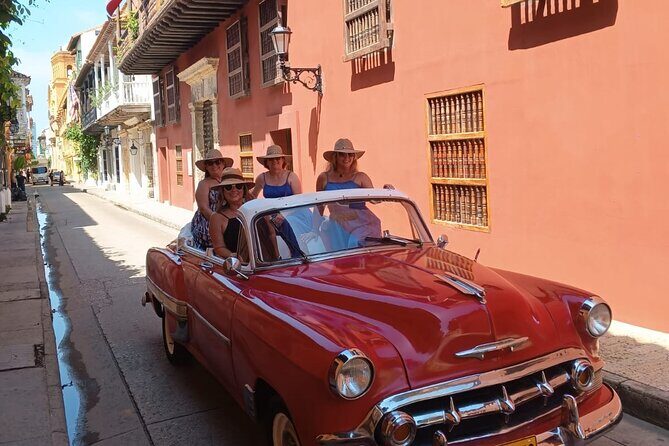
Cartagena is the kind of place where walking is beautiful… and also slow. The classic car format helps you cover ground while still stopping where the city looks its best: the stone walls, iconic towers, grand churches, and the big fort on the hill.
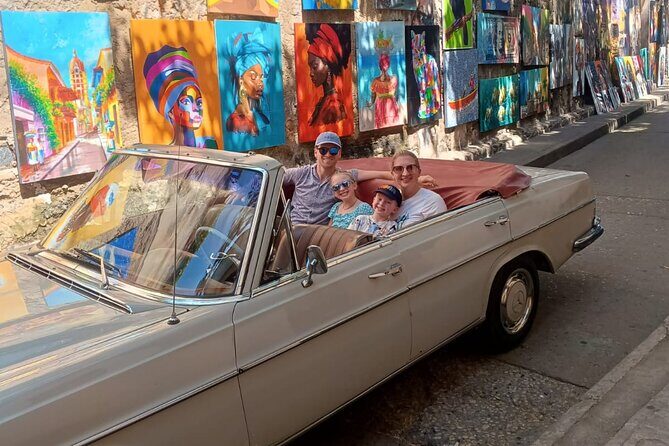
You also get the fun factor. Reviews describe the car as a real attention-grabber—one guest felt like they were riding through town like celebrities because other people were taking photos of them as much as they were photographing the city.
And because many of the stops are in the Historic Center, your eyes catch patterns quickly. You start noticing the mix of Spanish-era architecture, plazas laid out like stages, and the later layers of Cartagena’s street life.
Other classic and antique car tours in Cartagena



Price and group size: what $169 really buys you
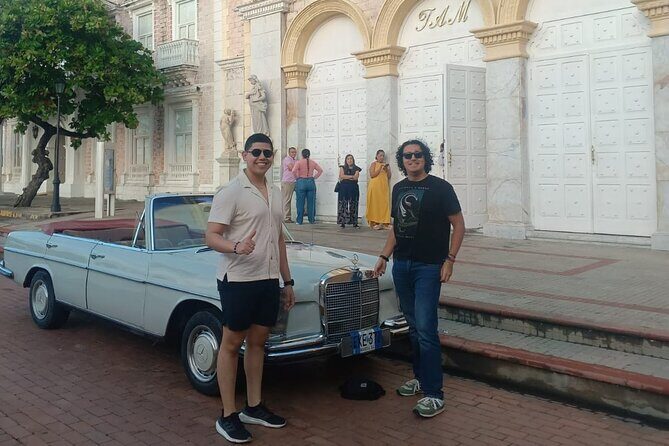
This tour is priced at $169 per group (up to 4). That matters because you’re not paying per person for a ride through the city—you’re buying a private classic-car experience for your small group.
It’s also a good value compared with “taxi plus guide” days. You get private transportation and a driver, plus a tour route with time at 12 major places. At $169, this is the kind of activity you can justify even if you’re also paying for one or two other paid tours that day.
One practical note: the listed duration is about 1 hour 15 minutes. This is not a long, deep storytelling tour. Think of it as a high-impact overview where the sights come first, and the guiding makes those sights make more sense.
The 90-minute route: a smart way to cover Cartagena fast
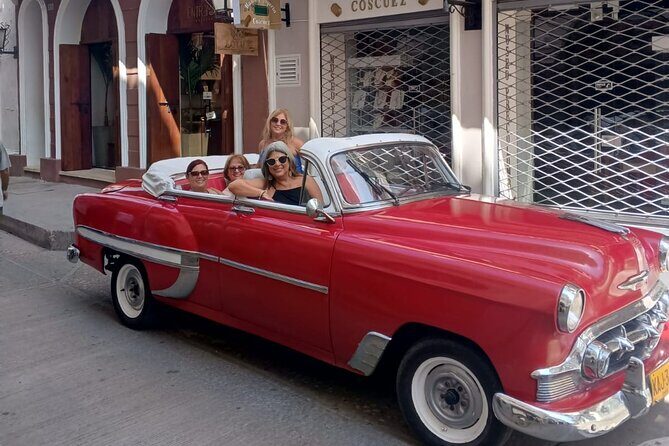
The itinerary is built around clusters. You start inside the Centro Histórico, move along the walled perimeter and iconic landmarks, then reach outward to places like Las Bóvedas and Getsemaní, before circling back through major plazas and big architecture.
Each stop is brief (around 5 minutes), so your plan stays light. That’s perfect if you’re on a cruise day, have limited time in the city, or want a classic-car experience without sacrificing your afternoons.
The route also makes a simple promise: you’ll see both the “postcard Cartagena” image and the everyday street energy. Getsemaní in particular gives you a taste of neighborhood life instead of only fort walls and cathedral views.
Centro Histórico, the city walls, and Torre del Reloj

Your first big moment is the Centro Histórico. Cartagena’s historic core is a World Cultural Heritage area, and the car ride helps you understand why people keep returning: you can see how the city’s design protects, channels movement, and frames views.
Then you roll past the Walled City of Cartagena. These defenses were built over a long stretch of time, designed to help the city survive repeated pirate attacks. Even if you don’t spend time reading every plaque, you’ll feel the “fortification mindset” in how the streets fold around the walls.
The stop at Torre del Reloj is one of the quickest ways to recognize Cartagena. This clock tower rises about 30 meters high between the plazas of Los Coches and La Paz, and it’s famous enough that it functions like a visual landmark. It’s also a natural place for photos because the tower anchors the whole scene.
What to expect here: your time at each stop is short, so don’t plan to study everything. Plan to look, take a couple of good photos, and let the guide point out the few details you’d otherwise miss.
Las Bóvedas and Getsemaní: where the story turns darker and more social
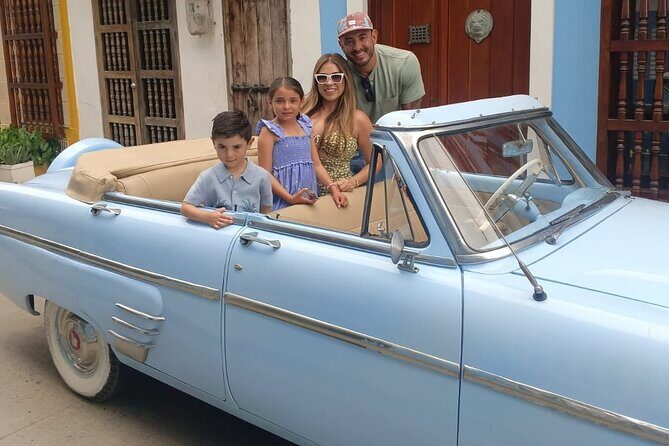
Las Bóvedas is the kind of stop that adds contrast. The Plaza de las Bóvedas sits inside the fortified perimeter and relates to colonial-era structures that later served as barracks and even a prison for patriots during independence and the early republic period.
You won’t linger long, but the setting gives the history weight. Even a brief pause helps you shift from “photo tour” mode to “wait, this place mattered” mode.
After that, you head toward Barrio Getsemaní. This neighborhood is known for mixing culture, festivals, gastronomy, and history. It’s the Cartagena side that feels more lived-in than the most formal stretches of the Historic Center.
If your comfort matters, this is also where you may notice Cartagena’s street temperature. Reviews mention it can get extremely hot, and in busy periods the noise and traffic can make it hard to hear commentary through the car ride. Keep that in mind and plan to ask questions early in the route, when things are quieter.
Other guided tours in Cartagena





Plaza de los Coches, Plaza Santo Domingo, and the “instant Cartagena” squares
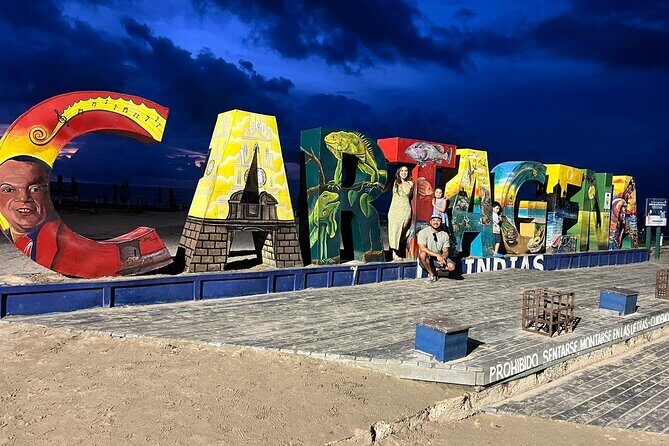
Two plazas pull double duty here: Plaza De Los Coches and Plaza Santo Domingo.
In Plaza de los Coches, you get another chance to frame the clock tower area and see surrounding features that visitors love. There’s also Portal de los Dulces, which is tied to Cartagena’s food and sweets reputation, so the square works well if you want a quick taste idea even if you’re not eating right now.
Then comes Plaza Santo Domingo, one of the busiest areas in the Historic Center. This is where you see traditional balconies and feel the restaurant energy. The church area—Santo Domingo—also anchors the plaza, so you’re not just in a commercial zone. You’re in a place shaped by major architecture and civic life.
Practical tip: because these are active squares, be ready for motion—people crossing, vendors nearby, and lots of photo angles. Bring a clear “what I want to photograph” plan so your time doesn’t disappear into wandering.
Teatro Adolfo Mejía (Heredia): European-style theater in Cartagena
The stop at Teatro Adolfo Mejía, also known as Teatro Heredia, offers a visual reset. It’s designed like an 18th- and 19th-century European opera house, with a horseshoe shape and boxes and balconies separated by cedar lattices that look lace-like.
This is the kind of building you appreciate more when you’re not rushing. The stop is still short, but it gives you the chance to catch the scale and style difference. Cartagena’s identity isn’t only fortresses and churches—this theater reminds you that the city also had cultural ambitions.
If you enjoy architecture, this is one of the more interesting “non-fort” stops. If you’re mostly here for views, it can still be worth it because it adds variety to the photos.
Catedral Santa Catalina and Castillo de San Felipe: two big icons, two different moods
Next you reach Catedral Santa Catalina de Alejandría. The cathedral is in the Herrerian style associated with Philip II’s reign and represents part of the Spanish Renaissance architecture timeline. For you, that means it’s a cleaner, more structured design compared with the ornate look you might expect from other religious buildings.
Then the itinerary shifts to power and perspective at Castillo de San Felipe de Barajas. This fortification sits on a hill called San Lázaro and was built starting in 1536. Even with a short stop, a fort like this changes your mental map. From here, the city’s defensive logic makes more sense.
What I’d watch for: on hot days, fort viewpoints can be tiring fast. If your plan includes multiple activities later, you might keep this as a photo-and-look stop rather than trying to read everything on site.
Old shoes, nightlife squares, and the best photo energy
A fun tonal shift comes at Monumento a los Zapatos Viejos—the sculpture of an old pair of boots. It’s one of Cartagena’s emblematic spots and it’s perfect for quick, playful photos.
Then you finish around Plaza de La Trinidad, which functions as an epicenter for nightlife. The square draws locals and visitors for conversations, street food, and even workout-like gatherings. In other words, it’s where you see Cartagena as a living city rather than a history stage.
This last area can be a great payoff if you want your tour to feel like more than landmarks. It’s also a reminder that the city isn’t frozen in time.
The driver, the car, and what comfort looks like in a classic vehicle
This tour includes a driver and uses private transportation. That’s important in Cartagena because the best routes can require flexibility—tight streets, pedestrian-heavy zones, and traffic patterns that change fast.
Reviews highlight a few real-world comfort points:
- Some classic cars are convertibles, so you might feel the sun more strongly.
- Older vehicles may not have modern driving comforts like power steering, which adds to the “period feel.”
- You might be able to access certain roads that normal traffic can’t, which can shorten the “where do we go next” problem and improve photo angles.
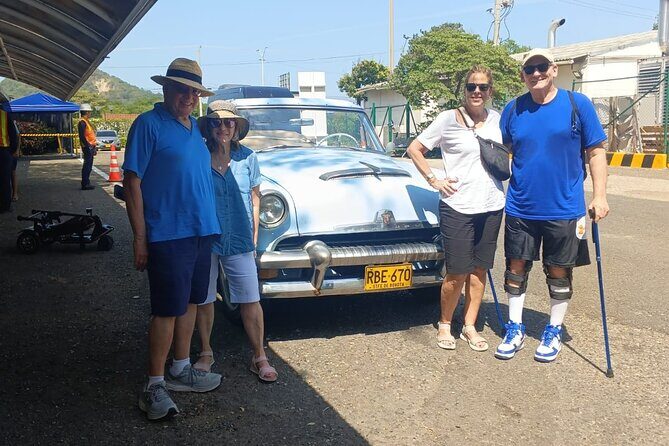
Also, if you’re doing this from the cruise port, meeting up can be a little chaotic. One guest said WhatsApp makes finding the driver easier when you’re at the port. I’d take that seriously: confirm your exact pickup spot and message the operator close to the start time.
Language and guide expectations: bilingual on the label vs bilingual in practice
The tour title emphasizes a bilingual historian guide, but the real experience depends on the guide assignment for your booking.
Some experiences described as bilingual still involved limited English. One review mentioned that the guide spoke no English at all, and the guest had to translate for family. Another described limited English but they made it work with Google Translate.
Here’s the practical way to handle this: when you book, verify what’s included in your specific option. If English explanations matter to you, ask for confirmation that your guide is truly English-forward, not just a Spanish-speaking guide who can answer basic questions.
If you’re Spanish-speaking, you’re likely to have a smoother time. If you aren’t, plan to use a translation app and focus on visuals plus the key facts you’ll get during stops.
Timing tips: heat, traffic, and that one rare downpour
Cartagena has a “yes it’s pretty” climate that can also wear you down. One review strongly recommended scheduling early in the morning before it gets too hot or later near sunset.
Traffic can also interfere. Busy driving routes can make it harder to hear commentary, especially if you’re stuck near loud intersections. For your best experience, aim for a time when the streets are calmer.
Weather is the wild card. One guest described a rare downpour that changed the classic car plan, and the company provided an alternative vehicle so the tour could still run. That’s a good sign operationally: you want a company that adapts rather than cancels outright.
Should you book the Cartagena Luxury Classic Car Tour?
I think this tour is a strong pick if you want:
- A high-sight, short-time overview of Cartagena
- A classic car experience that adds personality and great photo opportunities
- A private ride that feels easier than coordinating taxis while sightseeing
Skip it if:
- You’re expecting a long, detailed history lecture during the drive. This is about movement plus brief stops.
- English narration is non-negotiable. Because language support can vary, confirm the option clearly before you go.
If you’re on a cruise schedule or you only have a couple of hours to see the Historic Center, this is one of the more efficient ways to do it without feeling like you’re sprinting. You’ll likely come away with a clearer mental map of Cartagena—and a set of photos that look like you spent the day somewhere more cinematic than real life.
FAQ
How long is the Cartagena Luxury Classic Car Tour?
It’s approximately 1 hour 15 minutes.
What does the tour cost and how many people can it include?
It costs $169 per group, up to 4 people.
Is this a private tour?
Yes. It’s a private tour/activity, and only your group participates.
What’s included in the price?
You get private transportation with a driver, and pickup is included.
Are entrance tickets required for the stops?
For the listed stops, admission tickets are described as free.
Do I get a return transfer to my hotel or back to the port?
Return transfer isn’t included (so you’ll need your own way back).
What if I’m coming from the cruise port?
Pickup is included, but meeting the driver can be busy and crowded. Using WhatsApp can make it easier to locate your driver at the port.
Is it free to cancel?
Yes, free cancellation is available. You can cancel up to 24 hours in advance for a full refund.