Cartagena works best when you understand its layout. This walking loop connects the Clock Tower to the city’s most important plazas using stories you can actually place on a map. I especially love how the tour anchors you at the Plaza de la Inquisición, then keeps moving through squares that explain what the city was doing centuries ago, not just how it looks. The main downside? It is a 2-hour walk on cobblestones, so comfy shoes matter.
You get a bilingual guide and a tight route that hits big landmarks without wasting time. There’s also a nice rhythm to the stops: quick orientation moments, then a couple deeper stops where you can slow down and look closely at architecture and public spaces.
The pace is designed for small groups, max 30 people, so you can usually hear the guide and get your bearings fast. Just plan for sun and shade because most of the walking happens outdoors.
In This Review
- Key points to know before you go
- Getting oriented: starting at Plaza de la Aduana
- Stop 1: Torre del Reloj and the first real Cartagena landmark
- Stop 2: Plaza de los Coches and the heavy shadow behind a pretty square
- Stop 3: Plaza de San Pedro Claver and Eduardo Carmona’s presence
- Stop 4: Palacio de la Inquisición in Bolívar Square
- Stop 5: Plaza de la Proclamación and the Cathedral front
- Stop 6: Plaza Santo Domingo, cafes, and Botero’s Gertrude
- Stop 7: Plaza de la Aduana to finish, with your next day in mind
- Why the guide storytelling is the real value
- Price and time: is $48 a good deal for this route?
- Practical tips to get the most from the walk
- Should you book this Walking Tour of Cartagena’s Historic Center?
- FAQ
- How long is the walking tour?
- What does it cost?
- Is the tour offered in English?
- What’s included in the price?
- Are admissions included for the stops?
- Where does the tour start and end?
- How large are the groups?
- What is the cancellation policy?
- Are service animals allowed?
Key points to know before you go
- Clock Tower (Torre del Reloj) sets the whole route and is the classic meeting point
- Plazas matter more than museums here, with each stop tied to a specific story
- Bolívar Square’s Inquisition Palace adds context beyond postcard Cartagena
- You’ll see Botero’s Gertrude at Plaza Santo Domingo, a fun late-stop payoff
- Multiple major squares in about two hours makes this a strong first-or-second-day tour
- Mobile ticket and free admissions at stops keep the experience simple and good value
Getting oriented: starting at Plaza de la Aduana
Most Cartagena tours start with the walled-city clichés. This one starts in a way that helps you navigate the rest of your day. You begin at Plaza de la Aduana on Cl. 32 in El Centro, then work your way through the historic core toward the big squares people actually use.
That starting point is smart because Customs Square (Plaza de la Aduana) is the largest square in Cartagena. When a tour begins here, you quickly learn where the city’s colonial administrative and commercial life used to run. Even if you do nothing else that day, you end with a better sense of direction.
You’ll also walk along familiar-looking historic streets before you reach the first landmark. The route uses the classic connections through the center, so the tour feels like you are learning the city’s skeleton, not just ticking off photos.
Other Walled City and Old Town tours in Cartagena


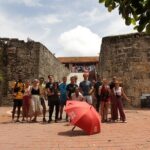
Stop 1: Torre del Reloj and the first real Cartagena landmark
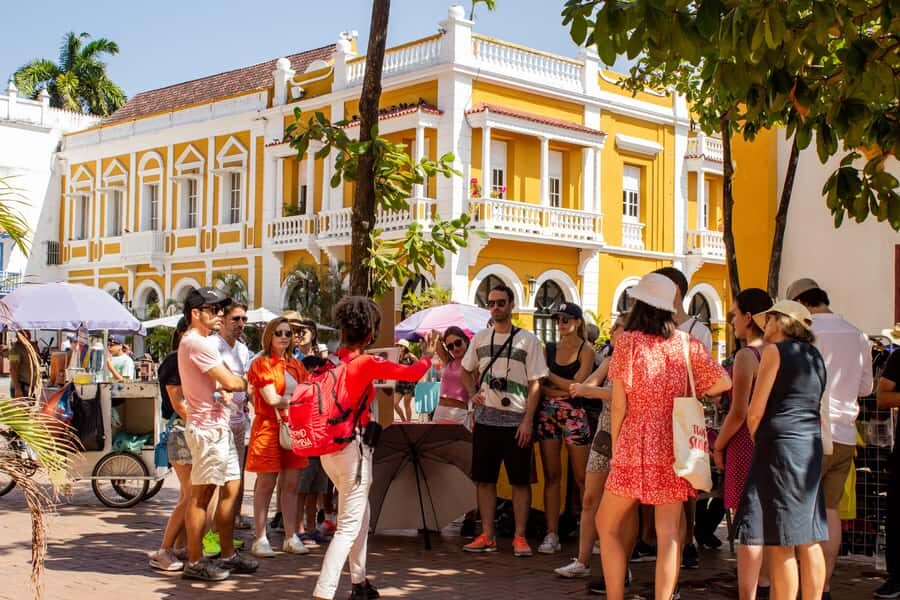
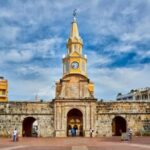
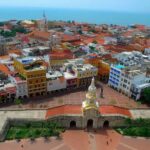
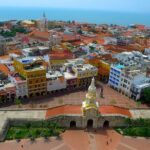
At the Torre del Reloj, you get the iconic yellow Clock Tower built in the 17th century. It is described as the emblem of Cartagena and the main gate of the Walled City. In practical terms, it is the anchor you can return to later because it functions as a meeting point you will hear locals and tour groups reference.
This first stop also matters because it frames how Cartagena grew. Instead of rushing into the walled area as a generic sight, you start at the edge—like learning the entrance to a story. If you want photos, this is one of the easiest places to get a clear landmark shot without extra effort.
Time here is short, about 15 minutes. That is perfect. You get the meaning of the tower, you get your bearings, and you move before the group starts to bunch up.
Stop 2: Plaza de los Coches and the heavy shadow behind a pretty square
Right near the Clock Tower is Plaza De Los Coches, which is also tied to Plaza de los Carcos. This is where the tour gets more honest. The square was a former slave market, and today it is a colorful colonial plaza with balconies and public details.
You’ll also notice a few things that keep the square from feeling like just a memorial:
- traditional Portal de los Dulces
- the statue of the founder, Pedro de Heredia
The value here is that you don’t treat the history as a footnote. You learn why the location carries weight, and then you can look at the architecture with better context. That makes your photos feel more grounded, because you know what happened in the same space you are standing in now.
One small consideration: because the story includes painful content, keep your expectations realistic. You are seeing Cartagena’s beauty and its reality in the same step.
Stop 3: Plaza de San Pedro Claver and Eduardo Carmona’s presence
Next comes Plaza de San Pedro Claver, across from the church of the same name. This stop shifts from colonial symbolism to the kind of cultural layering that makes Cartagena feel alive even when you are just walking.
The square is described as a space full of Eduardo Carmona’s history, art, and sculptures. That detail changes how you experience it. Instead of only reading old stone as “historic,” you start treating Cartagena’s public art as part of the city’s ongoing story—something people can see, meet, and use as a social space.
You get about 20 minutes here, which is enough to slow down. Look around and notice how the church and square shape each other. Streets feed into the space, and the architecture frames the square like a stage.
If you’re the kind of person who likes understanding why places feel the way they do, this stop is a good one. It gives you cultural context without forcing you into a long museum schedule.
Stop 4: Palacio de la Inquisición in Bolívar Square
Bolívar Square is where the tour turns into a major education stop: the Palace of the Inquisition. The building is one of Cartagena’s most iconic structures. It was formerly the seat of the inquisitorial court and today it functions as a museum that reveals colonial and republican history.
Even when you are only spending 15 minutes, this is a powerful pairing with what you saw at the earlier squares. You start with the city’s gate and founder symbolism. Then you move through a former slave-market space. Now you reach a site tied to coercion and control—an entirely different type of power.
The practical benefit is that your guide can connect the dots for you. You can look at the building as architecture, then step back and understand why it has endured in the public imagination. That kind of framing is exactly why a guided walking tour can outperform a self-paced stroll.
If you prefer your tourism more thoughtful than purely visual, you’ll likely appreciate this stop the most.
Other walking tours we've reviewed in Cartagena

Stop 5: Plaza de la Proclamación and the Cathedral front
After the Inquisition Palace, you continue to Proclamation Square (Plaza de la Proclamación) in front of Cartagena Cathedral. This is a photogenic pivot point because it connects major civic meanings with the classic colonial streetscape.
The square was the scene of independence in 1811, and the location is described as connecting with Bolívar Square and Customs Square. That connection is useful for you even after the tour ends: you start seeing the city as a network of linked public spaces rather than isolated landmarks.
You’ll spend about 20 minutes here, which helps because the Cathedral area tends to draw attention from everywhere. Take your time to observe the edges of the square—how the buildings face outward and how people naturally orient themselves around the open space.
If your instinct is to rush to the next postcard spot, this stop is a nice reminder to slow down for the “why” behind the architecture.
Stop 6: Plaza Santo Domingo, cafes, and Botero’s Gertrude
Plaza Santo Domingo is the tour’s liveliest stretch. It’s surrounded by cafes and restaurants, and the focus is both architectural and playful. You get the church of the same name, plus the famous Botero sculpture Gertrude.
This is a good moment to reset your energy. After the weightier stops, it helps to see how public space works as everyday social life. You’ll feel the contrast between “city power” squares and the ones where people linger over coffee and dinner plans.
Time here is about 20 minutes. That’s long enough to enjoy the atmosphere without feeling like you are stuck. If you’re planning to come back later, this is also a practical stop because it is built for night energy.
A small tip: if you want photos with Gertrude, aim for the edges of the plaza rather than the center, so you do not block foot traffic.
Stop 7: Plaza de la Aduana to finish, with your next day in mind
You end back near where you started—at Plaza Santo Domingo via walking connections that lead you back toward the broader center area. The tour’s final landing spot is Customs Square (Plaza de la Aduana), described as the largest square in Cartagena.
It is an old administrative and commercial center from colonial times, and today it’s surrounded by historic buildings and restaurants. That makes it a great finish, because you can easily continue your own plan without needing a new direction-finding moment.
This last stop also acts like a checklist. You can look at the square and recall the guide’s stories: where power sat, where commerce ran, and how public space shaped daily life. When a walking tour ends like this, it feels less like a “done” moment and more like you gained a tool.
Why the guide storytelling is the real value
The landmark details are impressive on paper. The real payoff is how the guide ties them together into a clear walking narrative.
In the experience you described, the guide is bilingual, and the pacing stays dynamic and easy to follow. One named guide you might encounter is Gustavo, who is highlighted for telling the history clearly and in a way that feels lively rather than like a lecture. That matters because Cartagena’s historic center can be visually overwhelming. A good guide helps you notice what you would otherwise miss.
Also, because the group is capped at 30, the guide can usually keep the tone conversational. That makes questions easier and helps you stay engaged instead of zoning out.
Price and time: is $48 a good deal for this route?
At $48 per person for about 2 hours, this is priced like a serious guided experience, not a quick “tour for photos.” You get a bilingual guide and a walking route that links multiple key plazas: Clock Tower, Plaza de los Coches, San Pedro Claver Square, Palacio de la Inquisición, Proclamation Square, Plaza Santo Domingo, and Customs Square.
The value pops because the stops are all described as admission ticket free. So your money is mainly paying for interpretation, not entrance fees. For a first pass through Cartagena’s historic center, that is a smart way to spend.
Where you might weigh the price: if you are traveling with someone who hates walking, or if you expect a long museum-style visit. This isn’t built as an all-day deep dive. It’s built as a tight, coherent circuit.
If you can handle 2 hours outside, you’ll likely feel you got your money’s worth.
Practical tips to get the most from the walk
A walking tour sounds simple until you’re on cobblestones in the heat. Do yourself a favor and plan for comfort first.
- Wear shoes that handle uneven stone.
- Bring water, even if you think you won’t need it.
- Have your camera ready, but let the guide finish a point before you start shooting.
- If you want the best photos at key squares, stand slightly off the main path so you don’t interrupt others.
Also, since the experience uses a mobile ticket and you receive confirmation at booking, keep your phone charged. You’ll want easy access to your ticket when you meet.
Should you book this Walking Tour of Cartagena’s Historic Center?
I’d book it if you want a smart first-time orientation through Cartagena’s historic center, with landmarks linked by meaning. The combination of major plazas, free admissions at the stops, and a bilingual guide makes it a good value way to understand what you are seeing.
Pass on it if you dislike walking on cobblestones or you want a slower pace with lots of indoor time. Also, if you prefer tourism that stays strictly upbeat, be aware that one stop connects to the former slave-market legacy.
If your goal is to leave with a clearer map in your head—where the city’s gate, power, independence moment, and everyday social life all connect—this is the kind of tour that makes your next few hours in Cartagena much easier.
FAQ
How long is the walking tour?
The tour lasts about 2 hours.
What does it cost?
It costs $48.00 per person.
Is the tour offered in English?
Yes. It is offered in English.
What’s included in the price?
You get a bilingual guide and squares and stories.
Are admissions included for the stops?
The stops listed are marked as admission ticket free.
Where does the tour start and end?
It starts at Plaza de la Aduana (Cl. 32 #130, El Centro, Cartagena de Indias) and ends at Plaza Santo Domingo (Cl. 35, El Centro, Cartagena de Indias).
How large are the groups?
The tour has a maximum of 30 travelers.
What is the cancellation policy?
You can cancel for free up to 24 hours in advance for a full refund. Canceling less than 24 hours before the start time does not refund the amount paid.
Are service animals allowed?
Yes, service animals are allowed.