REVIEW · CARTAGENA
Self-Guided Audio Tour of Getsemaní Neighborhood
Book on Viator →Operated by SOUNDWALKRS · Bookable on Viator
Street names tell better stories in Getsemaní. This self-guided audio walk through Cartagena’s Getsemaní lets you follow chapters at your own pace, using a mobile ticket with offline narration in English.
I like two things a lot. First, the tour includes offline chapters with maps and exploration tips, so you can keep moving without worrying about signal. Second, the street-level storytelling is voice-led, turning the neighborhood into scenes you can follow as you go.
One consideration: Getsemaní is often loud, and the narration includes character-style moments, so you may need to pause or rewind to catch everything clearly—especially in the busiest stretches.
In This Review
- Key things to know before you go
- Getsemaní by Soundwalkrs: how a self-guided audio tour works
- Price and value: what $10.72 buys you (and what it doesn’t)
- From Centro de Convenciones to Arsenal street: starting smart
- Chapter one to the big story: street names and a local hero
- Stop at the Convent: using landmarks to anchor memory
- Boat dealer and Pier: Cartagena’s waterfront logic in audio form
- Ending at Calle PacoPacoa: finishing strong near the action
- Listening tips for smoother audio in loud Getsemaní streets
- Who should book this Getsemaní soundwalk (and who might not love it)
- Should you book this Getsemaní Neighborhood Audio Tour?
- FAQ
- How long is the self-guided audio tour of Getsemaní?
- Is the tour available in English?
- Does the tour work offline?
- Do I need to bring a smartphone and headphones?
- Where do I start and where do I finish?
- What time is the tour available?
- What’s included in the price?
- Is there an admission ticket included?
- Can I cancel and get a full refund?
Key things to know before you go
- Offline audio plus maps: the chapters work without data, and you’ll get directions to help you explore beyond just the recording
- A short 30 to 60 minute route: perfect when you want history without committing half a day
- Start at Centro de Convenciones, then look for Arsenal street: the tour cues you to find the right spot to begin
- Story-driven stops: street-name background, a local hero, then landmarks like the convent and the waterfront
- You finish by Pacoa street: the ending sets you up to keep wandering Getsemaní after the walk
Getsemaní by Soundwalkrs: how a self-guided audio tour works
This is a private, self-guided experience, meaning it’s just your group using the audio—no waiting for other people. You get a mobile ticket and an English audio track broken into chapters, so you can walk your own pace and stop when you want. It’s also designed for short attention spans: plan on about 30 minutes to 1 hour depending on how much you linger.
In practical terms, this format is great for Getsemaní because the neighborhood changes scene to scene. One corner can feel relaxed, then the next feels more energetic and noisy. A guided walk can feel like you’re always catching up; an audio walk lets you slow down for street art, a viewpoint, or a moment you want to repeat.
Also, the tour runs essentially all day—Monday through Sunday, 12:00 AM to 11:30 PM—so you can pick the time that matches your style (quiet listening in the afternoon, or more atmosphere at night). And since it’s near public transportation, you’re not stuck unless you’re starting from somewhere far outside Getsemaní.
Other Getsemani tours in Cartagena



Price and value: what $10.72 buys you (and what it doesn’t)
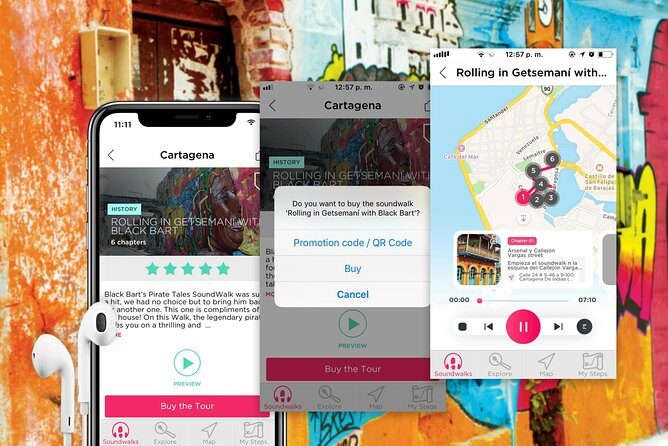
The price is $10.72 per person, and for this kind of tour, I think it’s strong value if you like walking and storytelling. You’re not just paying for audio—you’re paying for the whole structure: all chapters for offline use, plus maps and tips to explore Cartagena.
The parts that are not included are important to notice:
- Snacks
- Smartphone and headsets
- Admission ticket
That means the real “cost” isn’t just money. You’ll want to bring a charged phone and your own earbuds/headphones so you can actually hear the narration over street noise. If you forget, the tour becomes harder than it needs to be.
I also like that the duration is short. When a tour is only a half-hour to an hour, it’s easier to fit into a day of sightseeing—especially in a place like Cartagena where you might already be doing city-wall strolls or jumping between neighborhoods.
From Centro de Convenciones to Arsenal street: starting smart
Your starting point is Centro de Convenciones Cartagena de Indias, on Cl. 24 #8A-344, Getsemaní. The tour directs you to head over and then locate Arsenal street to begin the first chapter. Think of that first segment as your “get your bearings fast” moment.
A couple of practical moves help a lot here:
- Before you start walking, make sure your phone battery is healthy. Offline audio still takes power.
- Start with the volume set so you can hear narration even with background street sound. Getsemaní can be lively, and you don’t want to strain.
- Use the included maps as you go, not only at the beginning. The route is short, but it helps to verify you’re on the right street when the neighborhood gets busy.
Because you begin right near a major convention area, you typically won’t feel like you’re lost at the start. You’re walking into the neighborhood story, not trying to decode Cartagena from scratch.
Chapter one to the big story: street names and a local hero

Once you find Arsenal street, the audio kicks off. The tour’s next big storytelling phase focuses on Getsemaní through the name of the streets and connects those names to community history, including a local hero who lived among the neighborhood.
What I like about this approach is that it trains your eyes. Instead of treating the streets like scenery, you start noticing how geography and community identity connect. You’ll likely hear explanations that give you a reason to care about what you’re walking past—street names are the “map” the tour uses to turn walking into understanding.
This is also where the narration’s tone matters. The audio includes character-style voice moments, and at least one listener found it a bit chaotic in the loud streets, needing rewinding. That’s not a deal-breaker for everyone, but it’s a heads-up: if you hate repeating lines, plan for a slower pace in the noisiest parts.
If the street sound is getting in the way, don’t fight it. Pause, take a few breaths, and let the audio catch up. In places like Getsemaní, patience beats perfection.
Stop at the Convent: using landmarks to anchor memory

Next, you reach the Convent stop. Even without knowing every historical detail in advance, a landmark like this works well in an audio tour because it gives you a physical anchor. Instead of wandering aimlessly between story points, you get a clear destination, and your brain learns the route as it goes.
This section is valuable for one simple reason: it slows you down at the exact time you’d otherwise be rushing to “the next thing.” A convent is also the kind of place where the neighborhood story often intersects with religion, community life, and long-term urban change. The audio ties that landmark into the broader picture of Getsemaní’s past and identity.
Here’s how to make this stop pay off:
- Step back and look around before you listen again.
- Treat it like a photo pause, even if you don’t take pictures.
- If you’re listening while walking, consider taking 30 seconds to stand still here—this is often where the audio makes more sense when you’re not moving.
Other guided tours in Cartagena





Boat dealer and Pier: Cartagena’s waterfront logic in audio form
The tour then turns toward the water with stops including a Boat dealer and Pier. This is one of the best sections for people who like when a neighborhood story connects to how people lived day to day.
The waterfront theme tends to do a few things at once:
- It explains why certain streets feel connected to trade and movement
- It helps you understand the neighborhood’s rhythm, not just its buildings
- It gives you a change of pace, both visually and emotionally
I’d also pay attention to your surroundings here. Even if the audio is the star, this is where you can look up from your phone and notice what’s happening around you—the working energy, the paths people use, and the way the neighborhood edges toward the pier.
One practical tip: if you’re in this area at night, be mindful where you stop. You may want one hand free to steady your phone, and you’ll likely be standing near foot traffic. Keep your focus on safety first, audio second.
Ending at Calle PacoPacoa: finishing strong near the action
Your tour ends at Calle PacoPacoa #s/n, Getsemaní, specifically “stand in the corner of the Pacoa street.” Ending on a street corner is smart—it’s a natural “wrap” moment. You’re not left in the middle of nowhere; you’re placed where it’s easy to keep exploring.
This is a good time to do a quick reset. Since the tour itself is only 30 minutes to 1 hour, you can use the last minutes to decide what you want next:
- Follow the street art and side lanes you noticed earlier
- Grab a snack or drink nearby (since snacks aren’t included)
- Walk toward nearby city sights if your day plan includes them
I also liked the overall pacing in the way it leads you from street stories into landmark stops and then into the waterfront zone. You end with context, not just audio. That makes it easier to enjoy the rest of Getsemaní as more than background.
Listening tips for smoother audio in loud Getsemaní streets

Because the narration is delivered through your phone, your setup matters. Since headsets aren’t included, bring your own earbuds or headphones if you want the story to land clearly. You’ll also hear better if you:
- Start listening when you have a steady moment to concentrate
- Keep your phone screen brightness reasonable so you’re not distracted trying to read it
- Use a gentle pace if the streets are crowded, since stopping and restarting is normal in an audio tour
If you get knocked out of sync—because you turned a corner too fast, or the street noise covered a line—rewind and reset. One key complaint was that the experience felt chaotic and required rewinding, so treat rewinding as part of the tool, not a failure.
A small bonus: because the chapters include offline maps and tips, you can use the tour as a warm-up for longer wandering. Even when you finish the audio, you can keep using the same planning mindset—follow the directions, then choose your next streets based on what you like.
Who should book this Getsemaní soundwalk (and who might not love it)
This tour is a great match if you want:
- A short Getsemaní experience without committing to a long guided schedule
- English audio with offline chapters and practical maps
- A way to connect street names, landmarks, and waterfront areas into one walking story
It also fits solo travelers and small groups who like independence. Since it’s private for your group, you won’t feel “stuck” with a pace you didn’t choose. Service animals are allowed, and most people can participate, which matters if your travel style isn’t built around stairs-heavy, all-day excursions.
You might consider another option if:
- You strongly dislike any character-voice narration (some people find it takes over the pacing)
- You need quiet for listening and the neighborhood sound will frustrate you
- You prefer a live guide you can ask questions to, rather than an audio track you can only follow
Should you book this Getsemaní Neighborhood Audio Tour?
I’d book it if you want a low-cost, high-flexibility way to learn Getsemaní while you walk. The combination of offline storytelling, maps, and tips makes it more useful than a simple “press play and go” download. It’s also short enough that even if you’re tired or distracted, you’ll still get something meaningful.
Skip it if you’re the type who wants a perfectly quiet listening environment, because Getsemaní can be loud and you may need to pause or rewind. Also, if you’re expecting a classic museum-style guide with detailed facts at every stop, this is more about street-level storytelling and atmosphere than a lecture.
If your goal is to understand why the streets feel the way they do—and then keep exploring with a better mental map—this is a smart pick.
FAQ
How long is the self-guided audio tour of Getsemaní?
It runs about 30 minutes to 1 hour, depending on your pace.
Is the tour available in English?
Yes, it is offered in English.
Does the tour work offline?
Yes. It includes all chapters with offline use, along with maps and tips.
Do I need to bring a smartphone and headphones?
Yes. A smartphone and headsets are not included.
Where do I start and where do I finish?
Start at Centro de Convenciones Cartagena de Indias on Cl. 24 #8A-344, Getsemaní. The tour ends at Calle PacoPacoa #s/n in Getsemaní, where you should stand in the corner of Pacoa street.
What time is the tour available?
It operates Monday through Sunday from 12:00 AM to 11:30 PM.
What’s included in the price?
You get all chapters with offline use, plus maps and tips to explore Cartagena.
Is there an admission ticket included?
No, an admission ticket is not included.
Can I cancel and get a full refund?
Yes. Cancellation is free up to 24 hours in advance for a full refund. If you cancel less than 24 hours before the start time, the amount paid is not refunded.